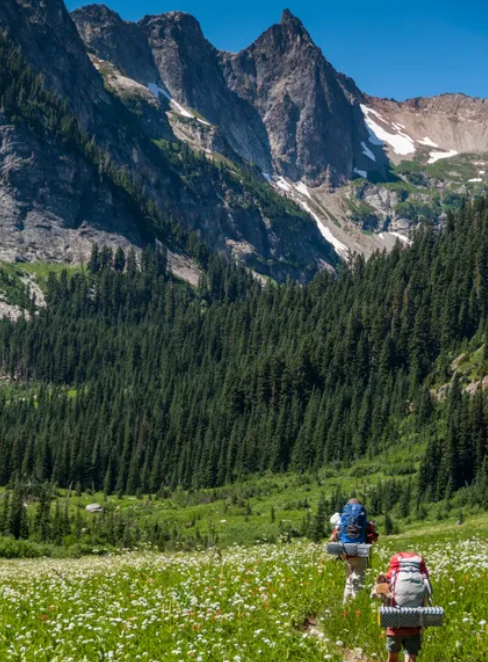
Deep in Washington’s North Cascades lies one of the Pacific Northwest’s most spectacular wilderness adventures: the Spider Gap–Buck Creek Pass Loop.
This remote backpacking route combines dramatic mountain scenery, glacier-carved valleys, alpine lakes, wildflower meadows, and challenging high passes into one unforgettable journey.
Covering approximately 40–45 miles over several days, this loop is not considered an easy backpacking trip. The route includes steep climbs, snow crossings, rugged terrain, and sections without maintained trails. However, for experienced backpackers looking for a true wilderness experience, few trails offer a better combination of adventure and scenery.
The Glacier Peak Wilderness remains one of Washington’s most impressive yet less crowded mountain areas. Surrounded by jagged peaks, ancient forests, and remote valleys, it provides the feeling of stepping into a landscape untouched by modern life.
Overview of the Spider Gap–Buck Creek Pass Loop
Location: Glacier Peak Wilderness, Washington State
Distance: Approximately 40–45 miles
Duration: 4–6 days
Difficulty: Moderate to challenging
Best Season: Mid-July through September
The route is usually completed as a multi-day backpacking trip starting near the Phelps Creek Trailhead and finishing near the Buck Creek Pass area.
Although often called a loop, the route actually connects two different trailheads, requiring a short vehicle shuttle between the start and finish points.
The main attraction of this adventure is the variety of landscapes encountered along the way:
- Alpine meadows filled with wildflowers
- Glacier-fed lakes
- Snow-covered mountain passes
- Remote Cascade peaks
- Old-growth forests
- Incredible views of Glacier Peak
The route’s biggest challenge is crossing Spider Gap, an unmaintained alpine pass that often holds snow well into summer.
The Challenge of Spider Gap
Spider Gap is the defining feature of this backpacking trip.
Located at approximately 7,100 feet, the pass sits between dramatic mountain walls and requires hikers to cross steep snowfields during much of the hiking season.
Early in the morning, snow can become frozen and extremely slippery. Later in the day, warmer temperatures soften the surface, making the crossing easier but potentially unstable.
Conditions change every year depending on snowfall and summer temperatures.
Backpackers should be prepared for:
- Snow travel
- Steep terrain
- Variable weather
- Navigation challenges
Basic snow skills are strongly recommended. Trekking poles, microspikes, or an ice axe may be useful depending on conditions.
For experienced hikers, however, crossing Spider Gap becomes one of the most memorable moments of the entire trip.
Standing above the surrounding valleys, surrounded by rugged peaks and endless wilderness, the effort feels completely worthwhile.
Spider Meadow: The Beginning of the Adventure
The journey begins through the beautiful Phelps Creek Trail, which gradually leads hikers into the heart of the Glacier Peak Wilderness.
One of the first highlights is Spider Meadow, a peaceful alpine valley surrounded by mountains.
During summer, the meadow transforms into a colorful landscape filled with wildflowers. Streams flow through the valley, and wildlife such as marmots and deer are commonly seen.
The area represents the classic beauty of the North Cascades:
- Green mountain valleys
- Snow-covered peaks
- Clear mountain streams
- Quiet wilderness surroundings
Many backpackers consider Spider Meadow one of the most beautiful sections of the entire route.
It also provides excellent camping opportunities before the climb toward Spider Gap.
Crossing Spider Gap into Upper Lyman Lakes
After leaving Spider Meadow, the trail climbs steadily toward Spider Gap.
The ascent becomes increasingly alpine as trees disappear and the landscape opens into rocky mountain terrain.
The final approach often involves crossing snowfields before reaching the pass.
From Spider Gap, hikers are rewarded with spectacular views of the surrounding peaks and valleys. Looking back, the route reveals the dramatic landscape that makes Glacier Peak Wilderness so special.
The descent from the northern side leads toward Upper Lyman Lakes, one of the most beautiful areas on the route.
Upper Lyman Lakes sit within a glacier-carved basin surrounded by cliffs, snowfields, and rocky mountain slopes.
The turquoise color of the water comes from glacial minerals, creating a landscape that feels almost unreal.
Camping at Upper Lyman Lakes
Upper Lyman Lakes provides one of the most memorable campsites along the route.
A small grassy area overlooking the basin offers incredible views of:
- Mountain peaks
- Alpine lakes
- Snowfields
- Glacier remnants
Evenings here are especially magical. As sunlight fades, the surrounding mountains glow with warm colors, while wildlife moves quietly through the valley.
Deer frequently pass through campsites, and marmots can often be spotted among the rocks.
The remote atmosphere creates the feeling of being completely separated from everyday life.
However, backpackers should prepare for insects during summer months. Mosquitoes can be extremely active around alpine lakes and wetlands.
A good shelter system, insect protection, and proper clothing can make the experience much more comfortable.
Cloudy Pass and the Pacific Crest Trail
Leaving Upper Lyman Lakes, the route continues toward Cloudy Pass and eventually connects with sections of the famous Pacific Crest Trail.
The scenery changes dramatically as hikers move through high alpine terrain.
During late summer, wildflowers cover the mountain slopes, creating one of the most colorful displays in Washington’s wilderness.
The climb toward Cloudy Pass offers panoramic views of:
- Snow-covered Cascade peaks
- Deep mountain valleys
- Glacier Peak in the distance
Despite its name, Cloudy Pass can provide spectacular clear-weather views.
From high points along the route, hikers can see endless ridges stretching across the North Cascades.
Image Lake: The Iconic View of Glacier Peak
One of the greatest rewards of this backpacking trip is the side trip to Image Lake.
Often considered one of Washington’s most famous wilderness viewpoints, Image Lake offers a breathtaking reflection of Glacier Peak rising behind the water.
The scene has become an iconic image of the North Cascades.
The lake sits in a small alpine basin surrounded by wildflowers, rocky slopes, and mountain views.
Reaching Image Lake requires extra effort, but many backpackers consider it the highlight of the entire route.
At sunset, Glacier Peak often glows with warm colors as the surrounding landscape becomes completely silent.
It is exactly the type of wilderness moment that makes long backpacking trips unforgettable.
Wildlife and Wilderness Experience
The Glacier Peak Wilderness supports a wide variety of wildlife.
During the trip, hikers may encounter:
- Marmots
- Deer
- Mountain goats
- Birds of prey
- Black bears
Because the area is remote, backpackers should practice proper wilderness safety:
- Store food securely
- Carry bear-resistant containers when required
- Maintain distance from wildlife
- Follow Leave No Trace principles
The lack of crowds is one of the greatest advantages of this route.
Unlike many popular national park trails, the Spider Gap–Buck Creek Pass Loop provides a genuine wilderness atmosphere.
Best Time to Backpack the Route
The ideal season is generally:
Mid-July to September
During early summer:
- Snow remains heavy
- Spider Gap may be difficult
- Navigation becomes more challenging
Late July and August usually provide the best balance:
- Wildflowers are blooming
- Snow crossings become easier
- Weather is more stable
September offers cooler temperatures and fewer insects, but early storms are possible.
Always check current trail conditions before starting.
Essential Gear Recommendations
Because of the remote terrain and changing conditions, proper gear is important.
Recommended equipment includes:
Navigation
- Detailed map
- GPS device or navigation app
- Compass
Snow Travel
- Trekking poles
- Microspikes if conditions require
- Ice axe for experienced users during early season
Backpacking Essentials
- Lightweight shelter
- Warm sleeping bag
- Water filtration system
- Rain protection
- Emergency supplies
Clothing
The North Cascades can experience rapid weather changes. Bring:
- Waterproof jacket
- Warm layers
- Gloves
- Sun protection
Final Thoughts
The Spider Gap–Buck Creek Pass Loop represents everything that makes backpacking in the Pacific Northwest special.
It is challenging enough to feel like a true adventure, yet rewarding enough to attract backpackers seeking some of Washington’s finest scenery.
From snowy mountain passes and glacier-fed lakes to wildflower meadows and unforgettable views of Glacier Peak, every section of this route delivers something unique.
For hikers who want to experience a remote wilderness journey away from crowded trails, this loop belongs among the best backpacking adventures in Washington State.