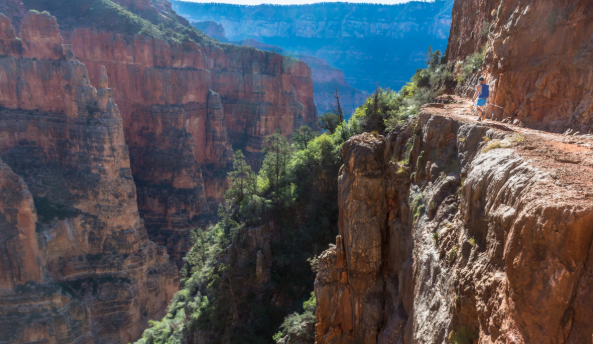
Long-distance day hikes offer a unique way to experience some of America’s greatest landscapes. Unlike backpacking trips, these adventures allow hikers to cover incredible distances while carrying only a lightweight daypack. There is no need to organize campsites, carry overnight gear, or plan complicated logistics.
A demanding day hike can provide the same sense of adventure as a multi-day backpacking trip while allowing you to explore more terrain in a shorter amount of time.
However, these hikes are not simple walks in the park. Many involve thousands of feet of elevation gain, extreme weather conditions, remote terrain, and long hours on the trail. Proper preparation, physical fitness, and experience are essential.
From the deep canyons of Arizona to the granite peaks of California and the rugged mountains of Wyoming, these challenging day hikes represent some of the most rewarding outdoor adventures in the United States.
1. Grand Canyon Rim-to-Rim-to-Rim, Arizona
The Grand Canyon Rim-to-Rim-to-Rim hike is one of the ultimate challenges for experienced hikers. The route crosses the canyon from the South Rim to the North Rim and returns again, creating an unforgettable journey through one of the planet’s most impressive natural landscapes.
The shortest version of this adventure covers approximately 40+ miles with more than 20,000 feet of total elevation change. Hikers descend deep into the canyon, cross the Colorado River, climb toward the opposite rim, and repeat the entire journey back.
The challenge comes not only from distance but also from the extreme environment. Temperatures inside the canyon can become dangerously hot, especially during summer months, while the elevation changes place enormous stress on the body.
Water availability, weather conditions, and pacing are critical factors. This hike should only be attempted by hikers with strong endurance and previous desert hiking experience.
For those who are ready, however, the reward is unmatched: dramatic canyon walls, constantly changing scenery, and the rare experience of seeing the Grand Canyon from multiple perspectives in a single day.
2. Logan Pass to Many Glacier, Glacier National Park, Montana
Glacier National Park is famous for rugged mountains, alpine lakes, and spectacular wildlife, and the traverse from Logan Pass to Many Glacier showcases some of the park’s best scenery.
The route combines sections of the famous Highline Trail with additional climbs and descents, covering roughly 16 miles. Along the way, hikers experience sweeping views of dramatic peaks, deep valleys, glaciers, and high alpine landscapes.
One of the highlights is the optional climb to the Grinnell Glacier Overlook, where hikers gain a viewpoint above one of Glacier National Park’s iconic frozen landscapes.
Wildlife encounters are common here. Mountain goats and bighorn sheep are frequently seen along the high ridges, while larger animals such as bears require hikers to stay alert and follow safety guidelines.
Although shorter than some extreme day hikes, the combination of distance, elevation changes, and remote mountain terrain makes this a serious adventure.
3. Tenaya Lake to Yosemite Valley, Yosemite National Park, California
Few day hikes offer as many famous Yosemite landmarks in a single journey as the route from Tenaya Lake to Yosemite Valley.
Covering approximately 20 miles, this challenging traverse takes hikers through some of Yosemite’s most spectacular terrain.
The adventure begins near the beautiful granite surroundings of Tenaya Lake before climbing toward Clouds Rest, one of Yosemite’s most impressive viewpoints. From the summit ridge, hikers can see Half Dome, Yosemite Valley, and countless granite peaks stretching across the Sierra Nevada.
The route continues toward Half Dome, where hikers can experience the famous cable section before descending through the Mist Trail.
Along the way, hikers pass two legendary waterfalls:
- Nevada Fall
- Vernal Fall
The combination of alpine scenery, granite landscapes, and famous Yosemite landmarks makes this one of the most memorable long-distance day hikes in America.
4. Zion National Park Traverse, Utah
Zion National Park is known for towering sandstone cliffs, narrow canyons, and dramatic desert landscapes. A full traverse of the park represents one of the most ambitious hiking challenges in the Southwest.
The complete route can cover more than 40 miles, depending on trail choices and side trips.
Hikers move through different environments, from high desert plateaus to deep canyon corridors. The scenery constantly changes, including:
- Massive red rock walls
- Narrow canyon passages
- High viewpoints
- Unique sandstone formations
Popular sections include the West Rim Trail and areas near Angels Landing.
Because of the length and elevation changes, completing the entire traverse in one day requires excellent fitness and careful planning. Many hikers choose shorter sections instead, which still provide incredible views without the extreme distance.
For experienced hikers, Zion offers one of the most spectacular long-distance adventures in the National Park System.
5. Paintbrush-Cascade Loop, Grand Teton National Park, Wyoming
The Paintbrush-Cascade Loop is considered one of the finest challenging hikes in Grand Teton National Park.
The approximately 20-mile loop climbs through dramatic mountain scenery, including deep valleys, alpine lakes, waterfalls, and jagged peaks.
One of the biggest highlights is Paintbrush Divide, located more than 10,000 feet above sea level. From this high mountain pass, hikers enjoy panoramic views across the Teton Range.
The trail also passes Lake Solitude, a stunning alpine lake surrounded by towering mountain walls.
Although many hikers complete this route as a backpacking trip, strong hikers can finish it as a demanding day hike. The combination of elevation, distance, and spectacular scenery makes it a true bucket-list adventure.
6. Presidential Range Traverse, White Mountains, New Hampshire
The Presidential Range Traverse is one of the most legendary challenging hikes in the eastern United States.
Located in New Hampshire’s White Mountains, this route crosses several major peaks, including Mount Washington, the highest mountain in the Northeast.
The classic traverse covers around 20 miles and includes more than 8,000 feet of elevation gain. Unlike many western mountain hikes, the difficulty here comes from the rugged terrain, steep rocky trails, unpredictable weather, and long sections above the tree line.
Hikers often spend hours walking across exposed ridges with limited protection from wind and storms. Mount Washington is especially famous for extreme weather conditions, including hurricane-force winds and rapidly changing temperatures.
The reward is a continuous mountain panorama stretching across the White Mountains. On clear days, hikers can see endless ridgelines, alpine valleys, and distant peaks.
Because of the unpredictable conditions, preparation is essential. Even during summer, hikers should carry warm layers, rain protection, navigation tools, and enough food and water.
For experienced hikers looking for a challenging adventure outside the western national parks, the Presidential Range Traverse is one of America’s best mountain day hikes.
7. High Divide–Sol Duc Loop, Olympic National Park, Washington
Olympic National Park offers an unusual combination of environments, including ancient forests, alpine meadows, rugged mountains, and coastal landscapes.
The High Divide–Sol Duc Loop is one of the park’s most rewarding long-distance day hikes, covering approximately 18 miles with more than 3,000 feet of elevation gain.
The journey begins in the lush temperate rainforest near Sol Duc Falls, where hikers walk beneath towering old-growth trees and alongside rushing mountain streams.
As the trail climbs higher, the landscape changes dramatically. Dense forests give way to open alpine meadows filled with wildflowers during the summer months.
The highlight is the High Divide Trail, where hikers walk along exposed ridges with incredible views across the Olympic Mountains. On clear days, Mount Olympus dominates the horizon with its glaciers and snow-covered summit.
Wildlife sightings are common, including mountain goats, elk, and black bears. The combination of rainforest, alpine scenery, and mountain views makes this hike feel like several different adventures combined into one.
Although demanding, it provides one of the most diverse hiking experiences in the United States.
8. Wind River Range Traverse, Wyoming
The Wind River Range is one of the most spectacular and remote mountain areas in America.
A long-distance traverse through the southern Wind River Range covers roughly 25–30 miles and provides some of the most dramatic alpine scenery in the Rocky Mountains.
The route travels through high mountain terrain, often remaining above 10,000 feet for extended sections. Along the way, hikers encounter:
- Massive granite peaks
- Alpine lakes
- High mountain passes
- Remote wilderness landscapes
One of the most famous highlights is the Cirque of the Towers, a breathtaking collection of granite peaks surrounding a natural alpine amphitheater.
Unlike popular national parks, the Wind River Range offers a greater sense of solitude and wilderness. Trails are more remote, navigation can be more challenging, and weather conditions can change quickly.
This adventure is best suited for experienced hikers who are comfortable with long distances, high elevations, and backcountry conditions.
For those seeking a true wilderness experience, few places compare with the Wind River Range.
9. The Narrows, Zion National Park, Utah
Although many hikers experience Zion’s Narrows as a backpacking trip, strong hikers can also complete a long day hike through this famous canyon.
The Narrows follows the North Fork of the Virgin River, where enormous sandstone walls rise hundreds of feet above the water.
Unlike traditional mountain trails, the route requires hikers to walk directly through the river. Depending on conditions, water levels may reach the knees or higher.
The unique environment creates an unforgettable experience:
- Towering canyon walls
- Flowing river channels
- Natural springs
- Waterfalls emerging from canyon walls
However, the adventure requires careful planning. Flash floods are the biggest danger, and hikers should never enter the canyon when storms are possible upstream.
Cold water temperatures can also make the hike physically demanding, especially during spring and fall.
With proper preparation, the Narrows offers one of the most unique hiking experiences in America.
10. Grand Canyon Hermit Trail and Backcountry Routes, Arizona
While the famous Bright Angel and South Kaibab trails attract most visitors, the Grand Canyon also offers challenging backcountry routes for hikers seeking a more remote experience.
The Hermit Trail is one of the classic difficult day hikes in the canyon. It descends steeply from the South Rim into a quieter and less crowded part of the canyon.
Unlike the maintained corridor trails, the Hermit Trail feels much more rugged and wild. Hikers encounter narrow paths, dramatic cliffs, and constantly changing views of the canyon’s geological layers.
The biggest challenge is the return climb. Every foot descended into the canyon must eventually be climbed back to the rim.
As with all Grand Canyon hikes, heat management and water planning are critical. A route that feels easy during the morning can become extremely difficult during the afternoon heat.
For experienced hikers, exploring the Grand Canyon’s less-traveled trails provides a deeper connection with this incredible landscape.
How to Prepare for Extreme Day Hikes
Long-distance day hikes require more preparation than normal hiking trips. Before attempting any challenging route, consider the following:
Build Your Endurance
Start training several weeks or months before your hike. Long walks, uphill training, strength exercises, and regular hiking will help prepare your body.
Carry Enough Water and Food
Many difficult hikes pass through areas with limited water sources. Always research water availability and carry enough supplies.
High-energy foods such as:
- Energy bars
- Nuts
- Trail mix
- Dried fruit
- Electrolyte drinks
can help maintain energy during long days.
Check Weather Conditions
Mountain and desert environments can change quickly. Check forecasts before leaving and be prepared for unexpected conditions.
Start Early
Many extreme day hikes require 10–15 hours on the trail. Starting before sunrise helps avoid afternoon heat and provides extra time for unexpected delays.
Know Your Limits
A challenging hike should be difficult but manageable. Turning around when conditions become unsafe is always the right decision.
Final Thoughts
America’s hardest day hikes provide some of the most rewarding outdoor experiences available.
These adventures combine physical challenge with unforgettable scenery, allowing hikers to experience landscapes that usually require multi-day backpacking trips.
From the depths of the Grand Canyon to the high peaks of the Rockies and the granite wilderness of Yosemite, each trail offers something unique.
However, difficulty should never be underestimated. Distance, elevation, weather, and terrain all play important roles in safety.
With proper preparation, realistic expectations, and respect for the environment, these extreme hiking routes can become some of the greatest adventures of a lifetime.